
Free quiz · 6 questions
Does your child get
enough vitamin D?
From October to March the sun in most of Europe is too weak for children's skin to make vitamin D — and food rarely covers the gap. Answer six short questions and see where your child stands, with a dose and product suited to their age.
- 4.8 / 5
- from 807 verified reviews
- Plant-based D3
- Vitashine® from lichen, vegan
- From 6 months
- gentle drops, no additives

Why it matters
Vitamin D is the nutrient children run short on first.
Half the year without sun
Between autumn and early spring the sun sits too low in Europe for skin to synthesise vitamin D — whatever the weather does.
Immunity, bones, teeth
Vitamin D contributes to the normal function of the immune system in children and to normal growth and development of their bones and teeth.
Food rarely covers it
Oily fish and egg yolks are the main dietary sources. Most children eat them a few times a month, not a few times a week.
The quiz
Where does your child stand?
Six questions, about two minutes. No email needed — your result appears straight away.
Vitamin D check for children
We ask about your child's age, time outdoors, diet and any signs you may have noticed — then show a clear result with an age-appropriate daily dose.
Informational only — not a medical diagnosis.
How old is your child?
This sets the dose we recommend at the end.
On a normal day, how long is your child outdoors?
Skin needs uncovered time in daylight to make vitamin D.
How strong is the sun where you live right now?
Season and latitude decide whether the sun can help at all.
How often does your child eat oily fish or egg yolks?
Salmon, mackerel, sardines, herring or eggs.
Does your child take vitamin D now?
Drops, spray or a children's multivitamin containing D3.
Have you noticed any of these lately?
One infection after another, unusual tiredness, restless sleep, leg or growing pains.
Your result · likely running low
Your child is very likely short on vitamin D
Little daylight, weak sun and a diet without much oily fish is the combination behind most children's deficiency — and nothing in that situation fills the gap on its own. A daily supplement through the whole low-sun season is the simplest fix, ideally with vitamin K2 alongside so calcium ends up in bones and teeth.
Your result · gaps to close
Your child is getting by — with gaps
Some of the basics are in place, but the supply is uneven: sunny weeks and outdoor days help, then a stretch of grey weather or a break in supplementation undoes it. Keeping a steady daily dose is what turns "sometimes enough" into consistently enough.
Your result · in good shape
Vitamin D looks well covered
Plenty of daylight, fish on the plate and a supplement in place — keep it going, especially once the sun gets lower. The nutrient most children in your situation still miss is omega-3 DHA, which works alongside vitamin D for the brain, eyes and immune system.
Recommended for your child

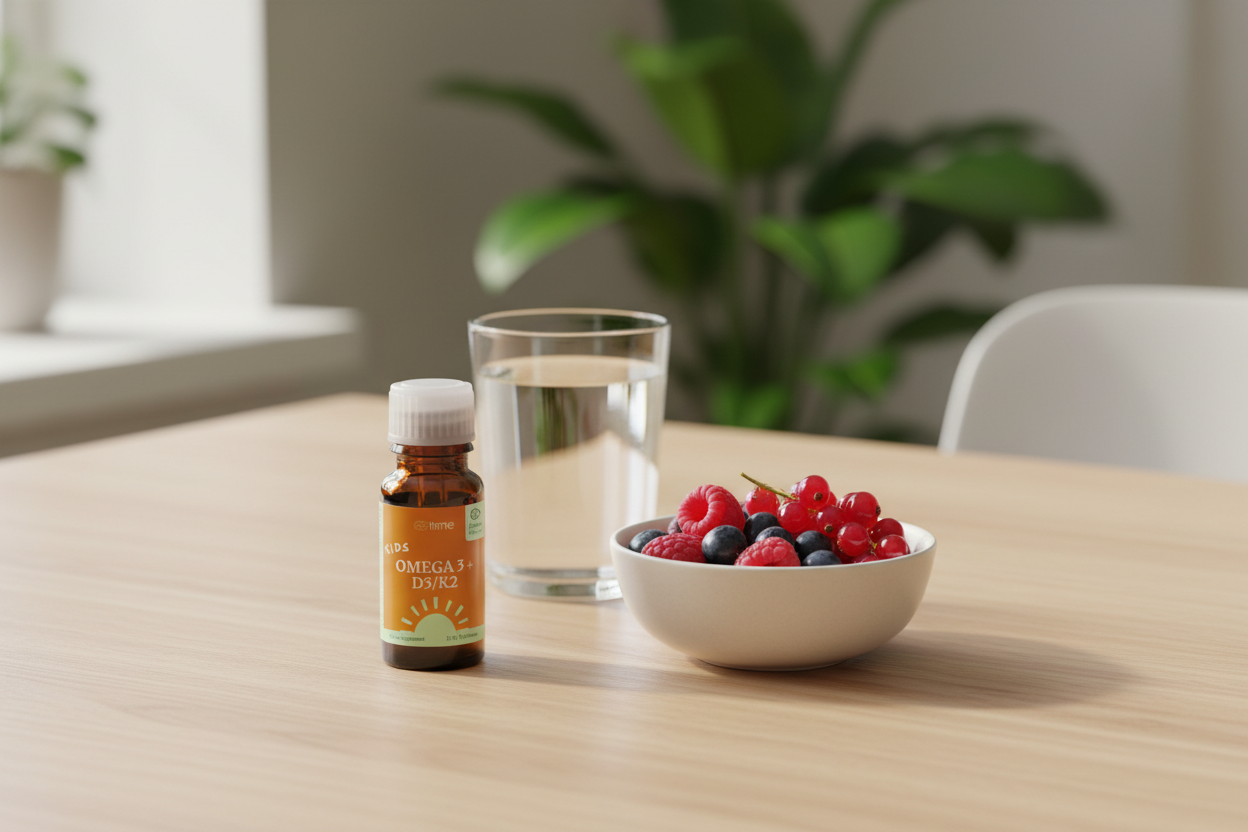
Kids Omega 3 + D3/K2
400 IU vitamin D3, 5 µg K2-MK7 and 250 mg omega-3 in one daily millilitre. Plant-based, from lichen and microalgae, in lemon or unflavoured.
Also worth having: Kids Vitamin D3 from €11,99 — pure D3 drops for babies from 6 months.

Kids Vitamin D3
One drop a day, 400 IU of plant-based Vitashine® D3 in organic coconut MCT oil. Suitable from 6 months, 250 doses per bottle — the easiest way to make the supply steady.
Covering omega-3 too? Kids Omega 3 + D3/K2 from €36,49 combines D3, K2 and DHA in one dose.

Kids Omega 3
DHA and EPA gently extracted from microalgae — no fish, no aftertaste. DHA contributes to normal brain function and vision, the nutrient most children still miss when vitamin D is covered.
Keeping D3 going through winter: Kids Vitamin D3 from €11,99.
This quiz gives general guidance based on your answers and is not a medical diagnosis. A blood test is the only way to confirm vitamin D status — if symptoms persist, speak to your paediatrician. Food supplements do not replace a varied diet.

Made for children
Drops you can give without a second thought.
We choose forms as close as possible to real food, then test every batch. No pesticides, no additives, no questionable fillers — the same bottles we give our own children.
- Plant-based D3 from lichen — vegan Vitashine®, not lanolin, in organic coconut MCT oil for absorption.
- D3 with K2-MK7 — the pair that helps calcium reach bones and teeth, from natural fermentation.
- One drop, no fuss — dosed straight onto a spoon or into food, with a mild lemon or unflavoured option.
- Tested, then labelled — every batch checked, everything on the label and nothing hidden behind it.
The essentials
What families usually start with


Parents keep coming back
4.8 out of 5 · 807 verified reviews
“I appreciate the clean ingredients and high-quality craftsmanship.”
“A high-quality multivitamin that really makes sense. I recommend it!”
“You can just take it, the taste is well disguised — it tastes of lemon.”
Good to know
Vitamin D for children, answered
Still unsure after the quiz? These are the questions parents ask us most.
When should children take vitamin D?
In most of Europe, supplementation is usually recommended through the low-sun months — roughly October to March — and year round for babies. If your child spends most days indoors, the whole year is worth considering.
Why combine D3 with K2?
Vitamin D helps the body absorb calcium; vitamin K2 helps direct it towards bones and teeth. That is why our Kids Omega 3 + D3/K2 and the family Vitamin D3 + K2, 1000 IU D3 / 25μg K2-MK7 pair the two.
Which is right — drops with omega-3 or plain D3?
If your child eats little oily fish, Kids Omega 3 + D3/K2 covers D3, K2 and DHA in a single daily millilitre. If omega-3 is already handled, Kids Vitamin D3 from €11,99 is the simple, low-cost choice.
Is it suitable for babies?
Kids Vitamin D3 is formulated for the youngest children from 6 months — one drop provides 400 IU. Follow the dosage on the label and ask your paediatrician if your child takes other supplements.
Can the quiz replace a blood test?
No. It maps the everyday factors behind most deficiency — daylight, season, diet, supplementation — so you can act sensibly. Only a 25(OH)D blood test measures actual status.
Two minutes now, a calmer winter later.
Answer six questions and get a clear dose for your child's age, plus the drops that fit — one-time or on subscription so you never run out mid-season.


