
Pregnancy Essentials - a whole food-based premium multivitamin for healthy moms and babies
Articles

Pregnancy is one of the most critical periods in a woman's and baby's lives. It is the time when new life develops and decides the future health of the unborn baby. The role of so-called nutritional programming is increasingly discussed today. This suggests that nutritional factors in pregnancy can have a long-term impact on the child's health, even into adulthood.[1] Ensuring adequate intake of essential nutrients is therefore essential for the mother's health and the baby's healthy development. Pregnancy Essentials is a pregnancy multivitamin based on real foods, designed specifically for women planning pregnancy, pregnant and breastfeeding moms. The daily dose (2 powder capsules and 1 liquid capsule) provides 400 µg of bioactive Quatrefolic® folate, 200 µg of iodine, 200 mg of choline and 18 mg of iron as iron bisglycinate.
What will you learn in this article?
- Why take a pregnancy multivitamin?
- The unique concept of Pregnancy Essentials
- Why are the substances in Pregnancy Essentials kept separately in two bottles?
- How to take Pregnancy Essentials?
- Why choose Pregnancy Essentials?
Why take a pregnancy multivitamin?
The nutritional profile of adult women of childbearing age often shows gaps in the intake of some nutrients. European data show low intakes mainly of vitamin D and some minerals.[2] In addition, the requirements for certain vitamins and minerals increase significantly during pregnancy, and poor eating habits or dietary irregularities further increase the need for these key nutrients.
For pregnant women, EFSA recommends 600 µg of folate (DFE) per day instead of 330 µg for other adults.[3] For iodine it is 200 µg instead of 150 µg[4], for choline 480 mg.[5] On top of that, an extra 100–200 mg of DHA is recommended in addition to the usual 250 mg of EPA and DHA.[6]
A lack of essential nutrients during pregnancy can contribute to health complications, such as developmental defects or premature birth.
For example, folic acid (folate) taken before conception and up to week 12 of pregnancy helps prevent neural tube defects.[7] Severe iodine deficiency can lead to disorders of brain and nervous system development.[8] According to a Cochrane review of 70 studies, a higher intake of omega-3 fatty acids during pregnancy reduced the risk of premature birth by 11%.[9]
Using an appropriately formulated pregnancy supplement helps ensure that the body receives important nutrients needed for the health of both mother and baby. A pregnancy multivitamin can therefore help cover the increased need for nutrients during pregnancy. Which nutrients to watch and in what amounts is covered in our overview of the most important nutrients for pregnant women. When to start supplementing is explained in the article on prenatal vitamins when planning a baby.
The unique concept of Pregnancy Essentials
Pregnancy Essentials is a whole food-based supplement, meaning it contains vitamins and minerals derived from plant sources. For example, the B vitamins, along with the minerals zinc, selenium and chromium, come from sprouted buckwheat seeds; iodine is provided in the form of dried seaweed powder; and beta-carotene (a precursor to vitamin A), along with a mix of other carotenoids, comes from algae growing in the salty Australian lagoons. Vitamin D3 comes from lichen and vitamin K2 (MK-7) from fermented chickpeas.
Folate as Quatrefolic®, vitamin B12 as methylcobalamin, choline as VitaCholine® and iron are added separately. Quatrefolic® is a form of 5-methyltetrahydrofolate (5-MTHF), the form the body itself converts folic acid into. However, the studies on neural tube defects tested folic acid, not 5-MTHF.[7]
Folate contributes to maternal tissue growth during pregnancy. Iodine contributes to the normal production of thyroid hormones and normal thyroid function. Iron contributes to normal formation of red blood cells and haemoglobin.
Daily dose of Pregnancy Essentials compared with EFSA recommendations for pregnancy
| Nutrient | Daily dose of Pregnancy Essentials | Recommended intake in pregnancy (EFSA) |
|---|---|---|
| Folate | 800 µg (of which 400 µg Quatrefolic®) | 600 µg DFE[3] |
| Iodine | 200 µg | 200 µg[4] |
| Choline | 200 mg | 480 mg[5] |
| DHA | not included | 100–200 mg on top of 250 mg EPA + DHA[6] |
EFSA recommendations cover intake from both food and supplements. The supplement covers iodine in full. It provides about 40% of the recommended choline; the rest should come from food, mainly meat, fish, dairy products and legumes.
Why are the substances in Pregnancy Essentials kept separately in two bottles?
Traditional pregnancy multivitamin complexes usually combine all vitamins and minerals in one capsule. However, many substances can interact with each other, which may reduce the stability of the supplement.
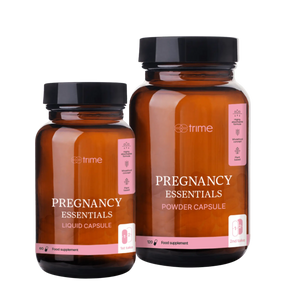
To preserve the natural form of each substance, we have split the Pregnancy Essentials formula into two bottles. One bottle contains powder capsules with B vitamins, zinc, selenium, chromium, iodine and choline (2 capsules a day). The other bottle contains lipophilic substances in olive oil, such as vitamin D, vitamin K2, vitamin E and beta-carotene (1 capsule a day).
Iron as iron bisglycinate, which is often difficult to store with other substances, is kept in a separate capsule. This is made possible by Duo Caps dual encapsulation technology, which protects sensitive ingredients so that they do not interact with one another and their stability and bioavailability are not reduced.
How to take Pregnancy Essentials?
The daily dose is 2 powder capsules and 1 liquid capsule, taken with food. You can take the capsules at once or split the dose during the day. One pack contains 120 powder and 60 liquid capsules, i.e. 60 daily doses.
You can take the supplement when planning a pregnancy, during pregnancy and while breastfeeding. Do not exceed the recommended daily dose. EFSA sets the tolerable upper intake level for folate for adults, including pregnant women, at 1,000 µg per day.[10] If you also take another supplement with folate, iron or iodine, discuss your total intake with your doctor.
Why choose Pregnancy Essentials?
Pregnancy Essentials places emphasis on the purity of its raw materials. The formula contains no artificial colours or preservatives and no animal-derived ingredients, so it is also suitable for vegans. The nutrients are in bioavailable forms, such as Quatrefolic® folate or iron bisglycinate.
The downside may be the higher price. However, the encapsulation technology that keeps all substances stable throughout the shelf life, the ingredients used and the clean formula without unnecessary additives come at a cost.
What to consider before adding the supplement
It does not contain omega-3 DHA. Pregnant women are advised to get an extra 100–200 mg of DHA per day. Sources are oily sea fish or a supplement, such as the vegan Omega 3 Algae from marine algae.
It does not contain calcium, magnesium or vitamin C. These nutrients need to come from food or another supplement.
It covers choline only partly. The daily dose provides 200 mg of the recommended 480 mg.
If you have a thyroid condition, consult your doctor. The same applies if your doctor has prescribed iron or other vitamins.
Key takeaways
Dosage: 2 powder capsules and 1 liquid capsule a day with food; one pack lasts 60 days.
Key nutrients: 400 µg Quatrefolic® folate, 200 µg iodine, 200 mg choline and 18 mg iron as bisglycinate.
Nutrient sources: B vitamins, zinc, selenium and chromium from sprouted buckwheat, iodine from seaweed, vitamin D3 from lichen. Suitable for vegans.
Folate and the neural tube: the protective effect was shown in studies with folic acid taken up to week 12 of pregnancy.
Limits: no DHA, calcium, magnesium or vitamin C; choline needs to be topped up from food.
Sources:
[1] Langley-Evans SC. Nutrition in early life and the programming of adult disease: a review. Journal of Human Nutrition and Dietetics, 2015; 28(Suppl 1): 1–14. https://doi.org/10.1111/jhn.12212
[2] Mensink GBM, Fletcher R, Gurinovic M, Huybrechts I, Lafay L, Serra-Majem L, Szponar L, et al. Mapping low intake of micronutrients across Europe. British Journal of Nutrition, 2013; 110(4): 755–773. https://doi.org/10.1017/S000711451200565X
[3] EFSA Panel on Dietetic Products, Nutrition and Allergies (NDA). Scientific Opinion on Dietary Reference Values for folate. EFSA Journal, 2014; 12(11): 3893. https://doi.org/10.2903/j.efsa.2014.3893
[4] EFSA Panel on Dietetic Products, Nutrition and Allergies (NDA). Scientific Opinion on Dietary Reference Values for iodine. EFSA Journal, 2014; 12(5): 3660. https://doi.org/10.2903/j.efsa.2014.3660
[5] EFSA Panel on Dietetic Products, Nutrition and Allergies (NDA). Dietary Reference Values for choline. EFSA Journal, 2016; 14(8): 4484. https://doi.org/10.2903/j.efsa.2016.4484
[6] EFSA Panel on Dietetic Products, Nutrition and Allergies (NDA). Scientific Opinion on Dietary Reference Values for fats, including saturated fatty acids, polyunsaturated fatty acids, monounsaturated fatty acids, trans fatty acids, and cholesterol. EFSA Journal, 2010; 8(3): 1461. https://doi.org/10.2903/j.efsa.2010.1461
[7] De-Regil LM, Peña-Rosas JP, Fernández-Gaxiola AC, Rayco-Solon P. Effects and safety of periconceptional oral folate supplementation for preventing birth defects. Cochrane Database of Systematic Reviews, 2015; (12): CD007950. https://doi.org/10.1002/14651858.CD007950.pub3
[8] Zimmermann MB. Iodine deficiency in pregnancy and the effects of maternal iodine supplementation on the offspring: a review. American Journal of Clinical Nutrition, 2009; 89(2): 668S–672S. https://doi.org/10.3945/ajcn.2008.26811C
[9] Middleton P, Gomersall JC, Gould JF, Shepherd E, Olsen SF, Makrides M. Omega-3 fatty acid addition during pregnancy. Cochrane Database of Systematic Reviews, 2018; (11): CD003402. https://doi.org/10.1002/14651858.CD003402.pub3
[10] EFSA Panel on Nutrition, Novel Foods and Food Allergens (NDA). Scientific opinion on the tolerable upper intake level for folate. EFSA Journal, 2023; 21(11): e08353. https://doi.org/10.2903/j.efsa.2023.8353


