
Vitamin D3 and K2: Why take them together and how they help with our health
Articles

Vitamins D3 and K2 each carry out a number of important functions in the body on their own. But when it comes to bone mineralization and cardiovascular disease prevention, they act synergistically. Together, they form a highly effective and powerful combination. It's even suggested that treating bone loss can hardly be done without combining these two vitamins. We're talking about the powerful vitamin duo K2 and D3. In this article, we'll explain why the two vitamins are combined, how they work, and in what ratio to take them.
What will you learn in this article?
- Why combine vitamin D3 and K2?
- The well-known vitamin D3
- Which form of vitamin K is linked to proper bone mineralization?
- Calcium metabolism
- Why vitamin D3 alone may not be enough
- In what ratio should you take vitamin D3 and K2?
- Who the D3 and K2 combination is suitable for
- Key takeaways
Why combine vitamin D3 and K2?
A sufficient amount of calcium is needed for healthy, strong bones. But even with plenty of calcium intake, it won't be absorbed into the body without vitamin D3. For calcium to actually reach the bones or teeth, vitamin K2 also needs to come into play. It activates the proteins that deposit calcium into bone tissue.
Put simply, vitamin D3 brings calcium into the body, while vitamin K2 helps determine where in the body the calcium goes. That's why the two vitamins are often combined in a single supplement. Together they support healthy, strong bones and play an irreplaceable role in keeping blood vessels and the heart healthy.
The well-known vitamin D3
Vitamin D3 is a major nutrient and an entirely essential regulator of calcium (and phosphorus) metabolism in the body. Beyond that, our immune system depends on vitamin D as well, both innate and acquired immunity, since it activates the production of protective antibodies against bacteria and viruses. It protects us against a range of infections, respiratory disorders, and lifestyle-related diseases, and its deficiency has also been linked to autoimmune conditions.
In the case of vitamin K, science took its time, and for a long time the different forms and their functions in the body were lumped together. Today it's clear that each of them plays a very important, but distinct, role in the organism.
Which form of vitamin K is linked to proper bone mineralization?
While vitamin K1 is involved in the blood clotting cascade, vitamin K2 significantly influences the composition of the bone matrix. It directs calcium molecules toward the bones and teeth, and prevents them from accumulating in the wrong places in the body, such as the blood vessels, kidneys, and other soft tissues, where, over time, they would cause significant problems.
Vitamin K2 MK-7 is the most usable form for the body. It's easily absorbed and, compared to other forms (such as MK-4), remains present in the blood the longest. You can read more about vitamin K2 in the article Vitamin K2 – vitally important, yet little known. Moreover, K2 MK-7 is precisely the form that helps carry calcium into the bones while also preventing it from accumulating in the blood vessels. We cover more health benefits in the article Why do we need vitamin K2?

Calcium metabolism
It's needed in the bones, but it can cause harm in the blood vessels. Osteocalcin is a protein synthesized by bone cells that plays a significant role in bone mineralization, specifically binding calcium to bone. Osteocalcin production is stimulated by vitamin D3, and vitamin K2 is required to activate it. Vitamin K2 also activates the matrix Gla protein (MGP), which prevents calcium from being deposited in the arteries, blood vessels, and soft tissues.
Why vitamin D3 alone may not be enough
Higher intake of vitamin D3 increases calcium absorption and boosts the production of K-dependent proteins (proteins whose activity depends on the presence of vitamin K; in bone, these are osteocalcin, matrix Gla protein, and protein S). Without vitamin K2, these proteins are unable to bind calcium to their molecule and lose their significance. As a result, we miss out on the benefits that vitamin D3 can otherwise provide in this role. Combining the two vitamins therefore makes particular sense at higher vitamin doses.
In what ratio should you take vitamin D3 and K2?
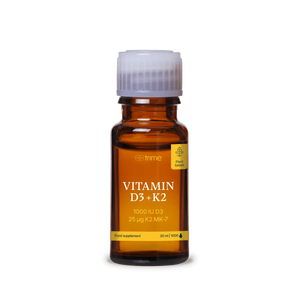
If you decide to increase your vitamin D intake, then it's almost unavoidable to take it together with vitamin K2. In practice, it works well to combine both vitamins in a single supplement, with roughly 50 mcg of K2 for every 1000 units of vitamin D being a suitable amount. For a higher vitamin K2 requirement, supplementation can be complemented with a standalone vitamin K2 capsule. The specific dosage should ideally be tailored to your blood vitamin D level. The combination of K2 and D3 is important not only for proper bone and dental development and osteoporosis prevention, but also for cardiovascular disease prevention.
Who the D3 and K2 combination is suitable for
The combination of vitamins D3 and K2 is especially valuable for adults who are supplementing with higher doses of vitamin D. The importance of supplementing this synergistic pair of vitamins grows with age, as the risk of bone loss increases.
We cover the benefits and effects of standalone vitamin K2 in more detail in the article Vitamin K2: effects, dosage, and how to take it.
Key takeaways
-
Vitamins D3 and K2 work synergistically: Together they support proper calcium metabolism and contribute to the health of bones, teeth, and blood vessels.
-
Vitamin D3 supports calcium absorption: It's essential for calcium absorption in the gut and also plays an important role in the immune system and a range of other physiological processes.
-
Vitamin K2 helps direct calcium to the right place: It activates proteins that deposit calcium into bones and teeth while also helping to prevent it from being deposited in blood vessels and soft tissues.
-
The K2 MK-7 form is among the most bioavailable: It persists longer in the body and effectively supports the activation of proteins important for bone and vascular health.
-
Supplementing vitamin D3 alone isn't sufficient: Higher vitamin D intake increases calcium absorption, but without enough vitamin K2, that calcium may not be properly utilized.
-
Getting enough of both vitamins matters long-term: Optimal intake of vitamins D3 and K2 helps maintain normal bone health and may support the prevention of osteoporosis and cardiovascular disease.
Sources:
[1] Charoenngam N, Holick MF. Immunologic Effects of Vitamin D on Human Health and Disease. Nutrients. 2020;12(7):2097. doi:10.3390/nu12072097. https://pmc.ncbi.nlm.nih.gov/articles/PMC7400911/
[2] Aaseth JO, Finnes TE, Askim M, Alexander J. The Importance of Vitamin K and the Combination of Vitamins K and D for Calcium Metabolism and Bone Health: A Review. Nutrients. 2024;16(15):2420. doi:10.3390/nu16152420. https://www.mdpi.com/2072-6643/16/15/2420
[3] Hao G, Zhang B, Gu M, et al. The combination effect of vitamin K and vitamin D on human bone quality: a meta-analysis of randomized controlled trials. Food & Function. 2020;11(4):3280–3297. doi:10.1039/C9FO03063D. https://pubs.rsc.org/en/content/articlelanding/2020/fo/c9fo03063h
[4] Tsugawa N, Shiraki M. MK-7 and Its Effects on Bone Quality and Strength. Nutrients. 2020;12(4):965. doi:10.3390/nu12040965. https://www.mdpi.com/2072-6643/12/4/965
[5] Rønn SH, Harsløf T, Oei L, Pedersen SB, Langdahl BL. The effect of vitamin MK-7 on bone mineral density and microarchitecture in postmenopausal women with osteopenia: a 3-year randomized, placebo-controlled clinical trial. Osteoporosis International. 2021;32(1):185–191. doi:10.1007/s00198-020-05638-z. https://link.springer.com/article/10.1007/s00198-020-05638-z
[6] Rønn SH, Harsløf T, Pedersen SB, Langdahl BL. Vitamin K2 (menaquinone-7) prevents age-related deterioration of trabecular bone microarchitecture at the tibia in postmenopausal women. European Journal of Endocrinology. 2016;175(6):541–549. doi:10.1530/EJE-16-0498. https://academic.oup.com/ejendo/article-abstract/175/6/541/6655114?redirectedFrom=fulltext&login=false


